Train The Trainer

  • Subscribe to our RSS feed.
  • Twitter
  • StumbleUpon
  • Reddit
  • Facebook
  • Digg

Friday, 29 March 2013

Does Speed Work work? My response to Mike Tuchscherer’s article. Part 1

Posted on 11:56 by Unknown

Does Speed Work work? My response to Mike Tuchscherer’s article. 
Part 1


INTRODUCTION

Mike Tuchscherer’s article Why Speed Work Doesn’t Work lifted a lot of dust lately. I have read Bret Contreras’, JL Holdsworth’s and Chad Smith’s responses and I have wrote some of mine ‘comment’ on Jim Wendler’s Facebook Wall. 

Today Mike contacted me and invited me to expand further and continue the discussion on his forum since he found my comment interesting. Thus I decided to write one blog entry as a starting point, along with explaining my rationale/viewpoint. 

I have huge respect towards Mike, what he is doing, both as a lifter and as a coach. I have learned a ton from him and he was really helpful with his responses to my emails and questions.   

Before I type anything I need to make couple of things straight. First of all I am not powerlifter nor I coach powerlifters. I do not coach strength athletes either, nor bodybuilders. I work with team sports athletes that demand a mixture of physical qualities ranging from power, speed, endurance, strength, but most importantly technical and tactical skill. I have some data on my own lifts by using Gym Aware LPT system which I will present shortly, but since I am weak as kitten (compared to elite powerlifters) take them with grain of salt (in more scientific term it is hard to make any inferences to elite powerlifting population from my own lifting samples). I will mainly reference some studies and use rational thought (that needs to be confirmed with scientific/empirical method). 


LOAD-VELOCITY PROFILE

Load-velocity profile [trade-off] is one of the most fundamental concepts in kinesiology, emerging in characteristics of single muscle fibers, single joints and finally of multi-joint complex movements. I am not sure we completely understand why it happens and what is the exact mechanism - even at the level of basic muscle fiber – and not even at the level of complex movements governed by even more complex nervous system.   

Anyway, load-velocity trade-off is there even if we don’t understand it completely. To make things simpler I will refer to common strength training movements like bench press and squat when I discuss load-velocity trade-off. I have written couple of articles regarding velocity-based strength training and using load-velocity profile of the lifter for estimating his 1RM and prescribing training HERE (make sure to follow links in the text). 

One can look at load-velocity profile as a formula, where velocity of a movement [V] is predetermined by external load [L]. 

V (L) = a x L + b

Constants a represent slope and constant b represent the intercept.  In short: velocity of a movement depends on the external load.  Here is my load-velocity profile for the squat (pause around 1sec at the hole). 

Load-Velocity profile for squat


As you can see correlation is nearly perfect between the two. I took 160kg as my 1RM and associated speed was 0.3 m/s (mean concentric velocity). If I use regression formula (one could use =TREND function in Excel, or manually by using slope and intercept), velocity at 160kg is estimate to 0.301 which is practically exact (as can be seen by low SEE). Thus one could use this regression to estimate 1RM.

Note that 1RM doesn’t always happen at 0.3 m/s. My bench press is somewhere around 0.15 m/s and this might depend on the level of the lifter (beginner, intermediate, advance), movement (small vs. large muscle mass involved), type of lifter (ST or FT, grinder or explosive), etc. So it is individual.


GOAL OF POWERLIFTING

What is the goal of powerlifting? The goal is to lift as much weight as possible without time reference. So one could lift 200kg in 4 sec and another might grind it for 20sec. Same results – so the movement velocity of 1RM doesn’t matter in powerlifting. 

Looking at the curve above the goal is to move 1RM to the right (i.e. from 160kg to 180kg). What happens with the slope of the curve doesn’t really matter – powerlifters are not competing who can generate more velocity with submax weights. This can’t be said for other sports!

Sometimes even if the 1RM doesn’t improve, if the velocity (and thus power output) at certain submax load (usually representing external resistance common to sport competitions [and NOT working around some magical load that produces peak power output]) improves that represent positive improvement. This is of no importance in powerlifting though.

Here is the possible scenario of me improving velocity without improving my 1RM which is still important in more [real] power dominant sports. 

Improvements in Velocity at without improvement in 1RM
And here is the possible opposite scenario of me improving my 1RM without much improvement velocities at submax load.

Improvements in 1RM without improvements in low resistance velocities

Third possible solution might be shifting the whole graph to the right by improving both 1RM and submax velocities. 

Improvements in both submax load velocities and 1RM

From a powerlifting standpoint the only important thing is improving your 1RM. Speaking of this I can improve my powerlifting result by not even affecting the load-velocity curve. You wonder how? By simply learning to grind more weight and in becoming more confident in it. Check the graph – I am learning to grind and I am able to lift 180 kg at lower speed. 

Improving grinding?

I am not sure if this is an improvement (development) or rather learning to express what one already have – and this goes pretty much in line with my develop~express concept. More experienced powerlifters and/or scientist might chine in on this topic. Also – can you change your grinding speed? Please chime in in the comments or on Mike’s forum. 

Going back to situation where the load-velocity curve improved so that 1RM improved, while velocity at submax weight didn’t (I am re-posting it again)


As you can see from the graph, as I have improved my 1RM I have also improved lifting velocities in the zone around 1RM. I am not sure if this is circular causation so the opposite is also true (i.e. improving velocities in the circa-maximal zone will improve 1RM). And I believe this is the CORE ISSUE here so I will bold it:

If improving 1RM also improves submax velocities, will improving submax velocities also improve 1RM? And who is first – chicken or the egg and what is the best way to improve each?

Since this is the chicken or the egg problem (as long as I don’t see experimental study with groups) automatically assuming process by the outcomes might be misleading. What do I mean by this? We have a tendency to believe/assume that using loads/velocities associated with one part of the curve will improve that same part of the curve. We can see this same rational flaw in distance running – and I HIGHLY suggest checking this great article by Steve Magness on Physiologial Model of Training (Note to Steve: if you are reading this I am still awaiting for the part two) and Attacking Adaptation from Multiple Directions.

 In plain English – will using circa maximal loads (90+%) improve 1RM better than submax weights over time? Will peak power be mostly improved by utilizing loads associated with it? Will VO2max be mostly improved by using VO2max workouts? Will lactate threshold be mostly improved by utilizing lactate threshold workouts? Is the best way to improve soccer skill by playing 10v10 all the time? And many more examples of develop~express confusion, misunderstanding of the specificity principle and training transfer along with highly mechanical/linear thinking.

I have written about this during 2009 in my Planning the Strength Training article, but I was mainly referring to the repetition continuum that you can see in most strength and conditioning textbooks: 

Repetition Continuum


It can be said that reaching of the different strength training goals (and thus motor qualities) is based on utilization of different loading protocols (weight, reps, sets, tempo, rest, etc.) or methods. So, each of the methods aimed at reaching different strength training goal utilize different loading protocols. This is based on the repetition continuum, or the ’idea’ that different goals can be achieved utilizing different reps per set. There is a dynamic interaction between the variables of reps, sets and loads. The load used (% of 1RM) ultimately determines how many reps per set are done. Reps per set (or set time) ultimately determines how many total sets must be done. The interaction between the three will affect what adaptation is seen. Although not all authorities agree, there is thought to be a continuum of adaptations which may occur with different repetition sets. This continuum is called repetition continuum. --- From Planning the Strength Training, 2009.

We have tendency to think this way and rationalize training methods, but it might be flawed. It is same as thinking that playing basketball will make you taller because basketball players are tall. Yes this is a bit extreme, but it is same flawed reasoning. 

Maybe I am nitpicking, but this might be reason of our frustration to understand same results with totally different programs and appreciate that what brought someone from A to B, might not bring him from B to C. 

Here is an example in running – the HIIT is quite popular and research is showing that runners who start doing more HIIT improve their performance and aerobic capacities more (there is the difference between improving VO2max and performance, see article by Steve Magness). And yet we see that most elite runners do mainly great volume of low intensity work and the ones who improved more did that by increasing low intensity volume instead of high intensity volume (see article by Seiler). 

When it comes to training we believe that the best way to improve 1RM (or strength) is to do loads very close to 1RM. And yet we have extremely strong lifters using Sheiko routines that are mostly 75-80%. It might be also interesting to read interview with Carlo Buzzichelli by Bret Contreras regarding this issue.

Enough for today – I have covered some basic theoretical/philosophical and maybe even practical aspects of this issue. I will leave you with the resources linked for now and continue soon with more practical words.

Stay tuned till part two…


Read More
Posted in analysis, Biomechanics, general vs. specific, GymAware, powerlifting, Research, strength training, Theory | No comments

Wednesday, 27 March 2013

Is power/speed reading in clean and snatch counterproductive (and other rant)?

Posted on 13:22 by Unknown


Just had a great talk with Travis Fisher regarding velocity-based strength training (he is only one I know using it and trying to figure out a solid system) and we touched a little bit on using velocity/power readings during Olympic lifts. Could one predict readiness (day to day variability) or 1RM by using velocity as with bench, squat, squat jump? 

As I have wrote in couple of articles using velocity of a lift one could create load-velocity profile and estimate 1RMs pretty reliably (see the research papers by Juan J. González-Badillo, Mário C. Marques and Luis Sánchez-Medina) along with prescribing training volume (using velocity drop offs) and intensity (by using velocity instead of % of 1RMs) and taking into account day-to-day variability in readiness. I believe there is a huge potential in this approach and I plan experimenting more with it and maybe writing a starting workout guide with Travis. 

This works perfectly fine with bench press, bench throws, squat, squat jumps and other exercises. It works even better if you provide immediate feedback (average velocity works better with non-ballistic movements, while peak velocity might work better with ballistic movements like bench throw or squat jump) during the lifts (as show in research). 

I was wondering about could this be used in clean and snatch? Could you (1) estimate 1RMs in clean and snatch from submax velocities (peak or average), (2) should you provide instant feedback in terms of power or velocity of the lift and (3) can you judge the daily readiness from variability in power/speed from the same submax weight? I believe it is simply more complex than the thing with squats, squat jumps and other exercises. 

I am not aware of any studies in this regard and if someone knows them please give me a heads up in the comments. Or if someone wants to give me a funding or PhD scholarship to do those (and a lot more) let me know too :)

So until I get more empirical data I will based my opinion on rational thought.

In short I believe answer to those questions is… no. Let me expand. 

In balistic movements the goal is pretty straight forward – lower the weight (quickly or not depends if one wants to utilize elastic energy and reactive strength) and explode up as much as possible. Power, force and velocity are estimated/measured during the concentric phase of the lift that starts from the bottom position (lowest reach/distance) and ends up at the highest point in the movement. This might be tricky – it is questionable should one use the total distance of the barbell as concentric range (this involves flight phase) or only while the barbell is in the arms (in the case of bench throw) or until the full triple extension (in the case of squat jump). This again depends of the protocol used (protocol dependency) as I have pointed out in this article. 

As Dan Baker commented on it: it doesn’t matter as long as it is improving over time. But it makes comparison between exercises a lot harder. And this is especially important since we like to compare exercises and choose camps along with writing nice headlines: dynamic effort squats create more power than Olympic lifts; max power output happens around 50% of 1RM, the highest power output in jump squats is with bodyweight only, etc. But I digress. 

How the things are measured matters. 

My jump squat with 20kg using GymAware system. I have added phases with arrows. Notice that phase used for calculus includes both concentric phase and part of the flight phase. 

When it comes of Olympic lifts the things are not that straight forward as with other ballistic movements (even they have certain nuances).  They are a lot more technical and they have phases that are interdependent. And besides this not all phases are done with highest effort. For example, if you rush in the first pull you might end up screwing the second pull and totally losing the lift. 

I am not expert on Olympic lifts, but I think those who are will agree with me. 

If we measure power, force or velocity of a lift it is questionable where one should start and stop the measurement (as with bench throw and squat jump example). Should the measurement start from the ground or during the second pull? Should it end on the highest point of the lift, or at the highest position of the triple extension? 

Even if we get this measuring issue straight it is still questionable if one could use it to estimate 1RM or provide daily readiness estimates.  

Here is an example. Suppose my 1RM clean is 150kg. I do sets with 100kg. I attach the LPT to the bar to get power output or velocity. I do this submax clean without looking at the numbers. Then someone say try to generate more power or more speed by providing me instant feedback during the lift. How will this goal/constraint affect my technique? 

One might rush the first pull to get higher average power or velocity. One might increase the power of the second pull to get the higher bar height which might end up in doing power clean or even muscle clean. 

Please note that this might happen with the squat as well – one might end up being on toes or even leaving the ground. Thus measurement MUST be within the technical model of the exercises and sometimes providing a non-specific feedback might end up screwing up the technique itself.
At the end – what is the goal of the clean? To lift as much weight as possible, or to produce the highest power output (especially with submax weights)? 

I am not aware of anyone getting a gold medal in being able to produce most power output during the clean & jerk (who knows, maybe with Crossfit we might end up having those medals as well). Power output is the side-effect. It happens when you optimize the movement. I am not sure that the power output or velocity improvement during the submax lifts should be the goal and/or feedback with Olympic Lifts. 

Yes – you maximum power will be increased as your 1RM increase with the clean and snatch, but should the goal of training be improving power output with submaximal lifts per se? Or something else? 

My question would be what would be specific feedback during the Olympic lifts then? Could it be single blind (where the athlete is not aware of being tested/measure) power/velocity of the second pull (could this be used to create load-velocity profile and estimate of 1RM)? Or could it be something more elegant and complex than pure linear power/speed? Like rhythm, timing, depth? Olympic lifting is a skill.

This might be the same thing that happened to sprint analysis – vertical or horizontal forces, stride rate or stride frequency, flight time or contact time? Then we have coaches focusing on maximizing/minimizing those and forgetting about the bigger context, about the skill, about total movement, relaxation, rhythm, elegancy.

“Make things as simple as possible, but not simpler” as said by Albert Einstein.

 I have spoken with couple of athletes and coaches that said that the highest power and highest velocity happens when they relax and let it happen. My boxing coach said he was never able to knockout anyone when he really pursued it by aim to hit them hard – but instead it happened when he relaxed and let it happen. Sprinters reach highest speed and jumpers highest jump when they are most ‘relaxed’ and effortless. 

So the whole point of this rant if mind your feedback. Not all feedback is created equal. Check the bigger context. 

Another message is the importance of understanding how the things are being measured and estimated. So it is not so simple to state what movement created more power output – clean or squat jump, because they don’t have exactly the same movement goals and constraints.  

Safety (along with skill learning) might also affect the selection of power development exercises. For example in clean you accelerate the barbell up and catch it couple of inches below the top height. With squat jump you accelerate the barbell up in the air and then you drop for a lot more inches from the peak height down to the ground. This creates a lot of impact due the difference between peak height and start of the catch/amortization. One also need to take into account the eccentric part of the squat jump when you quickly lower the barbell and quickly reaccelerate it (in the case of countermovement squat jump). 

The difference between highest position of the barbel and the catch position might be very important in eccentric stress and injury potential (IMHO) 

Thus cleaning 60kg (not with a cloth though) is a lot safer than squat jumping 60kg IMHO. And a lot of researchers doing squat jumps with a lot of kilos uses Smith machine with pins and/or special breaking devices. In my opinion it is a lot safer to use hex barbell jumps than squat jumps. If you use them (especially with a lot more weight than 30% squat 1RM) it might be wise to do it in a cage with safety pin and doing it only concentric wise. But this again depends on the athlete/sport.


This is me doing pretty high concentric squat jumps from safety pins. GymAware uses angle corrections


Read More
Posted in analysis, Biomechanics, GymAware, monitoring, Olympic lifting, Performance Analysis, powerlifting, strength training | No comments

Thursday, 21 March 2013

The problem with [Peak] Power [calculus] – or why I don’t believe in this Sacred Cow

Posted on 14:38 by Unknown

I am going to say it straight ahead – coaches who believe that they are training peak power at certain percentage of 1RM are simply misguided.


There are two important logical errors behind it [IMHO]. First one is the belief that there is a magic bullet – a certain % of 1RM intensity that will result in peak power output and in return training with that peak power output will result in great transfer [power and explosiveness] to all other zones or related activities (e.g. improving power using jump squats will improve sprint speed, jump height or even 1RM). Using that intensity you are training [mythical creature in Platonistic world of motor abilities] POWER. Using any other intensity you are not training power.

Second one is the belief that there is peak power. This peak power is TOTALLY dependent on the way/method it is being calculated. There could be 100+ methods of calculating it and all of them will result in different % of 1RM (Range: 0-80% 1RM). Let me expand. To get power, one needs two variables: instant velocity and instant force.

When it comes to velocity one could measure velocity of COM [Center of Mass] of both the athlete and barbell or only velocity of barbell. This will create different velocities. This could be also measured using 1-LPT [Linear Position Transducer], 2-LPT or 3D video analysis.

When it comes to force one could measure it using force plate directly or estimate it by using reverse dynamics [speed is derivative of position, acceleration is derivative of velocity and force is acceleration times mass involved] from positions derived by using LPTs. Also, estimating force from acceleration demands multiplying it with the moving mass. What is moving mass? Is it barbell only or body weight and barbell? Someone use 90% of body weight, some use 100% and some use 0%.

When we decide on all of these then we have range of movement. Are we going to use full concentric ROM or only part of it where acceleration is >0 [Fmuscles = Fgravity]? Or when Fmuscles start to actually break the movement (which actually happens with lighter loads – you engage the antagonists to stop the movement) and that the point where P [power] < 0.

Are we going to take into account average power over ROM or peak power over ROM?

Taking all of these into consideration it could be confidently said that the peak power concept is measurement/analysis dependent. And even if it existed I doubt that training at that intensity will provide a magical transfer to everything else that demands power output.

Another thing I actually hate is seeing this in studies. Researchers measured 1RM and power output at 50% or any other percentage of that 1 RM. Training over time improved 1RM. Then they measure power output at the same 50% or any other percentage of the new 1RM. Depending on the method of measurement (see the above) they might see statistically insignificant (don’t get me started on this B.S. concept) change in power output or even a drop. So they conclude that improving 1RM doesn’t (statistical) significantly improve power output. Well, duhhh. What about measuring it and comparing it at the same absolute weight, like P60kg (power output with 60kg)?

So, after all this rant what is the solution? One should do needs analysis and check what are the loads and resistances one needs to move during one’s sport. Then one needs to increase the SPEED and EXPLOSIVENESS at which one is able to move those around (including bodyweight). Improving this demands working over the full force-velocity continuum and applying different methods of training and not only trying to find peak power intensity that is going to magically improve everything else. First of all this isn’t going to happen and second it is measurement dependent and really hard to find. One exception to this rule might be cycling. They measure external power and they can manage the gears to take advantage of it. This peak power is usually around 80-100RPM (if I remember correctly), but the cyclist also train at cadences above/below that. 

To conclude - One needs to train to be more powerful (faster, more explosive) over a range of intensities  instead of focusing on one small zone.


Read More
Posted in Biomechanics, strength training, Theory | No comments

Monday, 11 March 2013

[Research] Velocity Loss as an Indicator of Neuromuscular Fatigue during Resistance Training

Posted on 17:21 by Unknown

[Research] Velocity Loss as an Indicator of Neuromuscular Fatigue during Resistance Training


Med Sci Sports Exerc. 2011 Sep;43(9)
Sánchez-Medina L, González-Badillo JJ.
Source
Faculty of Sport, Pablo de Olavide University, Seville, Spain. lsmedina@upo.es

PURPOSE:
This study aimed to analyze the acute mechanical and metabolic response to resistance exercise protocols (REP) differing in the number of repetitions (R) performed in each set (S) with respect to the maximum predicted number (P).

METHODS:
Over 21 exercise sessions separated by 48-72 h, 18 strength-trained males (10 in bench press (BP) and 8 in squat (SQ)) performed 1) a progressive test for one-repetition maximum (1RM) and load-velocity profile determination, 2) tests of maximal number of repetitions to failure (12RM, 10RM, 8RM, 6RM, and 4RM), and 3) 15 REP (S × R[P]: 3 × 6[12], 3 × 8[12], 3 × 10[12], 3 × 12[12], 3 × 6[10], 3 × 8[10], 3 × 10[10], 3 × 4[8], 3 × 6[8], 3 × 8[8], 3 × 3[6], 3 × 4[6], 3 × 6[6], 3 × 2[4], 3 × 4[4]), with 5-min interset rests. Kinematic data were registered by a linear velocity transducer. Blood lactate and ammonia were measured before and after exercise.

RESULTS:
Mean repetition velocity loss after three sets, loss of velocity pre-post exercise against the 1-m·s load, and countermovement jump height loss (SQ group) were significant for all REP and were highly correlated to each other (r = 0.91-0.97). Velocity loss was significantly greater for BP compared with SQ and strongly correlated to peak postexercise lactate (r = 0.93-0.97) for both SQ and BP. Unlike lactate, ammonia showed a curvilinear response to loss of velocity, only increasing above resting levels when R was at least two repetitions higher than 50% of P.

CONCLUSIONS:
Velocity loss and metabolic stress clearly differs when manipulating the number of repetitions actually performed in each training set. The high correlations found between mechanical (velocity and countermovement jump height losses) and metabolic (lactate, ammonia) measures of fatigue support the validity of using velocity loss to objectively quantify neuromuscular fatigue during resistance training.


This is VERY interesting study, especially taking into account my recent interest in velocity-based strength training (LINK, LINK, LINK).

The authors did a bunch of novel things:

Established velocity-load profile

Tested for 1-RM, 12-, 10-, 8-, 6- and 4-RM

Utilized 3 sets of Bench Press or Squat of different relative intensity over 8 weeks (3 × 6[12], 3 × 8[12], 3 × 10[12], 3 × 12[12], 3 × 6[10], 3 × 8[10], 3 × 10[10], 3 × 4[8], 3 × 6[8], 3 × 8[8], 3 × 3[6], 3 × 4[6], 3 × 6[6], 3 × 2[4], 3 × 4[4])

Performed Vertical Jump for the Squat group and bench/squat at load at estimated 1 m/s before and after 3 set protocols to assess neuromuscular fatigue, along with measuring lactate levels and ammonia.


Neuromuscular fatigue and velocity loss over 3 sets of 12 @ 12RM. Taken from Med Sci Sports Exerc. 2011 Sep;43(9) 

What the authors wanted so see is how different reps combinations (how close to failure – a concept explained by excellent system by Mike Tuchscherer) affect neuromuscular and metabolic fatigue.
Here are some of the findings:

...To the best of our knowledge, this is the first study to analyze the acute response to manipulating the number of repetitions actually performed in each training set with regard to the maximum number of repetitions that can be completed

...Our results indicate that, by monitoring repetition velocity during training, it is possible to  easonably estimate the metabolic stress and neuromuscular fatigue induced by resistance exercise.

...The present study confirms that the magnitude of velocity loss experienced during RT gradually increases as the number of performed repetitions in a set approaches the maximum predicted number.

...A finding worth noting is that greater MPV losses were experienced for BP compared with
SQ for all protocols analyzed

... In the present study, very high and significant correlations (r = 0.91–0.97) were found between the three different types of mechanical measures used to assess neuromuscular fatigue (Figs. 2 and 3A, B). These relationships are an important finding for the quantification and monitoring of training load during RT. The fact that there exists such a close relationship between loss of MPV over three sets and loss of MPV with the V1 mIsj1 load in two exercises as different as SQ (Fig. 2A) and BP (Fig. 2B), as well as between both variables and loss of CMJ height in the SQ group (Figs. 3A, B), is a novel finding that emphasizes the validity of using percent loss of repetition
velocity within a set as an indicator of neuromuscular fatigue.

... The relationships observed in Figure 2 also mean that, for a given percent loss of velocity within a set, the degree of fatigue incurred during RT is very similar irrespective of the number of repetitions the subject is able to perform (shown in different colors in Fig. 2), at least in a
range from 4 (~90% RM) to 12 (~70% RM) repetitions.

... Lactate increased linearly as the number of performed repetitions approached the maximum predicted for each type of REP (Table 1) and showed extremely high correlations (r = 0.93–0.97) with loss of MPV over three sets (Fig. 4A), loss of MPV pre–post exercise with the V1 mIsj1 load (Fig. 4C), and loss of CMJ height (Fig. 3C).

... Lactate increased linearly as the number of performed repetitions approached the
maximum predicted for each type of REP (Table 1) and showed extremely high correlations (r = 0.93–0.97) with loss of MPV over three sets (Fig. 4A), loss of MPV pre–post exercise with the V1 mIsj1 load (Fig. 4C), and loss of CMJ height (Fig. 3C).

... Although some studies have reported the point within a set where a significant reduction in velocity (18) or power output (1,26) was observed, the optimal time to terminate a set before reaching failure has never been clearly established.Although the present study does not come up with a definitive answer to that question, it does, however, provide us with some valuable information that may indicate when it could be appropriate to end a set. According to our
results (Table 1; Figs. 3 and 4), a maximum MPV loss of ~30% for SQ and ~35% for BP could be established to prevent blood ammonia to significantly rise above resting levels.

... Monitoring repetition velocity during resistance exercise seems important because both the neuromuscular demands and the training effect itself largely depend on the velocity at
which loads are lifted. A velocity- or power-based approach to RT is not entirely new, and authors such as Bosco (5) and Tidow (37) already provided some initial guidelines for putting it into practice. However, the role placed by movement velocity has not been sufficiently investigated (28). The findings obtained in the present study strongly support the use of velocity monitoring to control the degree of incurred fatigue.

… Furthermore, the immediate velocity feed feedback the athlete receives during each session may increase the potential for adaptation. With this training approach, instead of a certain amount of weight to be lifted, strength and conditioning coaches should prescribe resistance exercise in terms of two variables: 1) first repetition’s mean velocity, which is intrinsically related to loading intensity (15); and 2) a maximum percent velocity loss to be allowed in each set. When this percent loss limit is exceed the set must be terminated. The limit of repetition velocity loss should be set beforehand depending on the primary training goal being pursued, the particular exercise to be performed, as well as the training experience and performance level of the athlete.

... In conclusion, the present data show that the relationship between the number of repetitions actually performed in a set and the maximum predicted number that can be completed
is an important aspect to take into account when prescribing resistance exercise because the velocity loss and metabolic stress clearly differ when manipulating these variables. The high correlations found between mechanical (velocity and CMJ height losses) and metabolic (lactate,
ammonia) measures of fatigue support the validity of using velocity loss to objectively quantify neuromuscular fatigue during RT. The nonlinear response of blood ammonia to loss of repetition velocity could perhaps be used as a reference to indicate the point within a set where the exercise
should be terminated when the main training objective is to improve movement velocity or maximal power production.

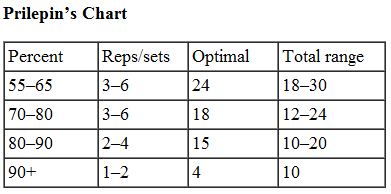
This reminds me very much of the Prilepin table


Using these recommendations power/velocity loss during the set won’t be bigger than 30-35% as suggested by this article.

I describe one potential approach of prescribing exact % 1RM to be used, but instead of prescribing exact number of reps one could use reps zone (to allow for day to day variability in readiness), but also, if one is equipped with system like GymAware, use quality threshold (QT) – or a maximum percent velocity loss to be allowed in each set.

This quality threshold is very much in line with Mike Tuchscherer’s RPE system (Fatigue Percents and Critical or proximity of failure – of course taken into account that all reps are done with maximum effort.
There is one studydone by using 80% quality threshold on experienced bench pressers with great results compared to the group that done sets to failure and without compensatory acceleration.  Results are so great that they are a little bit ‘fishy’. Anyway very interesting study and training concept indeed.
I think with the help of systems like GymAwarewe will tend to see coaches devising and utilizing more examples of velocity- or power-based strength training.

I am ‘experimenting’ with this at the moment. Just today I performed Bench press at 85% of 1RM with quality threshold set to 80% of the first rep. My first rep average velocity was 0.37 m/s and I set up the alarm on GymAware to 0.29 m/s. I end up doing 10 sets of 2 reps with 2 min rest. One could stop doing sets when one can’t maintain minimum velocity for the first reps with set rest time, or when one exceeds allotment time per exercises (this idea by Charles Staley although I saw Joe Kenn and Mike Tuchscherer using the same; this way productivity is a lot bigger, along with controlling larger group of athletes in the gym).

There are certainly different methods to do this and this might be just one of them. Anyway, one could create different stress and workout goals by prescribing different intensities and quality thresholds. For example intensive workouts should prescribe a bit heavier %1RM, lower QT (keep the quality) and longer rests. Volume (or extensive) workouts should prescribe a little lower %1RM, bigger QT (allow higher fatigue) and shorter rest. One could play with these variable to create different types of workout depending what is more the goal of it, what load aspect is being stresses (quality, grinding, intensity, intensiveness, volume, etc) or what of cycle is being utilized.

I believe velocity- power-based strength training will gain more popularity especially in power and mixed sports in the time to come. 


Read More
Posted in analysis, Biomechanics, Download, Good Reads, GymAware, monitoring, Performance Analysis, periodization, planning, powerlifting, programming, Research, RPE, strength training, team sports, Theory | No comments

Sunday, 3 March 2013

Running based intervals – Velocities table [Update]

Posted on 10:47 by Unknown
I just updated the Excel file and added the typical workouts for the categories. The DOWNLOAD LINK is still the same. Enjoy


Read More
Posted in | No comments

Saturday, 2 March 2013

Running based intervals – Velocities table [Free Download]

Posted on 11:57 by Unknown

I have recently finished a simple Excel file with classified methods I sometimes use when it comes to running based intervals (and cross-training). Most of them are based on work by Dan Baker, Joel Jamieson, Martin Buchheit plus some of my tweaks. 


Please note that this is a work in progress and ratios between %HRmax, MAS, v30-15IFT, VT1, VT2 are on average - individuals tend to vary. Look at this as guidelines and use your common sense and experience to adapt it. 


Please be free to modify it and/or attach your own methods. I won’t expand much on how to use it – Play and discover :) You can modify the yellow field and the template will calculate the paces.

Click HERE to download
Read More
Posted in conditioning, Download, energy system development, Excel, IE20-10, programming, runnings | No comments

Monday, 11 February 2013

Using PowerTool/GymAware: short video and explanation

Posted on 05:00 by Unknown
Using PowerTool/GymAware: short video and explanation


We have been using GymAware for the past year, but recently we acquired the Pro version of the software that allows automatic data collection, data-basing, analysis, reports and what else on the cloud.  This makes life much easier and also allows for tracking much more than a single parameter.

What we have been using it for the past year is to track mean external power output in the countermovement squat jump with 20 kg. This allowed to see trends with the players and gain some ideas on their freshness and readiness.

Statistical methods used to analyze the trends were rolling averages of the last 6-10 measurement used to get Z-Scores of the each individual. This way we can see trend, but also how much is one away from his normal variability (Z-Scores). The yellow flag was usually set to -1 to -2 and red flag for everything under -2 for Z-Scores. This is used besides visually checking for the trends over time (one could use rolling average to smooth the curve).

One thing with this method is that one needs to accumulate enough data to get more reliable estimates. But that’s always true with anything related to statistic. To make more confident claims, one need better and bigger data. 

Random data to show the calculus and visual representation

What we plan doing this year is doing the same, but with Pro software we can track more variables to gain insight which one is more sensitive to readiness changes. Things like mean power, peak velocity, dip, jump height. It is easy because everything goes directly to the cloud. No need to write things on paper.

Besides this simple use, we use it to track improvements in squat with estimating 1RMs on load-velocity profile. I wrote about it here. You can check the short reportage from one gym session in Boson Olympic Center in Stockholm, Sweden.


The beauty of this approach is that it is submaximal (except for the speed of movements which should be intended to be as fast as possible within technical limits of the exercise). There are two ways to assess 1RM – actually finding 1RM or doing reps-to-technical failure and estimating 1RM from the tables (makes sure that the reps are around 3-6). Using velocity approach is novel method and I am still figuring out what is the best way to do it.

Basically one could do 3 reps at 55%, 65%, 75% and 85% as fast as possible. Research states that it is more reliable to track mean velocity instead of peak velocity of the rep. Also, one could use best rep or set average. I would use set average since it is less prone to errors I guess. The velocity difference (fastest – slowest) should be more than 0,5 m/s (talking about mean velocity method) – you might need to change % a bit to make this possible. This is important to get more valid and reliable regression coefficients. One could also play with standard error and get confidence intervals  and thus more magnitude based statistics to assess (real) change over time.

Load-velocity profile
 Next comes the selection of the speed for 1RM estimate. It is usually around 0,2 – 0,4 for mean velocity (not peak velocity). This depends on the lifter, exercise, depth of movements, etc. One could also use LD0  (resistance at velocity = 0) but not as real/training 1RM, but rather as an indicator of change happening.

What is nice about this approach is that it could be done ANYTIME. It doesn't need to detract you from your normal workouts. Could be done with the warm-up sets and some working sets. And using this, athletes get the idea why it is important to be strong to lift fast and be fast/explosive overall. It is also easy to see trends (with strength athletes this might be their monitoring tool to see the effectiveness of training/block and judge when to switch or modify the program – more on this in some future articles).  Also, it removes the idea of grinding the weight, especially with the team sport athletes. Only technical and fast reps.

The negative side is of course errors in calculus. I am searching to find the best method (valid, reliable and sensitive) of doing it to assess real changes and correlate it with real 1RM. Athletes should also strive to lift as fast as possible and by lifting light weights slower one could easily “cheat” to get higher estimate, since that would flatten the curve. Anyway, until then I advise not to use estimated 1RM as training 1RM, but rather as an indicator to increase training 1RM. For example, if an athlete uses 140kg as his training 1RM (one that is used to calculate all the weights based on percentage – see more here) and over a training cycle his estimated 1RM at 0,4 m/s improves for 5-10kg, it might be a good idea to increase his training max for 5 kg. This brings me back to developing vs. expressing concept I alluded in numerous blog posts.

Having Pro account of GymAware it is now easy for me to collect data and do my own research to find the best method of load-velocity based estimates of 1RMs.

Stay in touch because more is on the way….


Read More
Posted in analysis, Excel, GymAware, monitoring, Performance Analysis, powerlifting, programming, Random Thoughts, statistics, strength training, team sports, Theory, videos | No comments
Newer Posts Older Posts Home
Subscribe to: Posts (Atom)

Popular Posts

  • Playbook: Understanding MODERATION through simulation
    Playbook: Understanding MODERATION through simulation Playbook: Understanding MODERATION through simulation Introduction I rece...
  • Intensity-Effort Table for Strength training
    Intensity-Effort Table for Strength training Continuing on my rant on three parameters of intensity in strength training I decided to updat...
  • Olympic lifting matrix
    I was training yesterday with a friend of mine, playing with GymAware Pro (with a Web support and BTW I am AMAZED how powerful this tool ...
  • Periodization Confusion?
    I have recently been reading Transfer of Training  (Volume 2) by Dr Anatoly Bondarchuk an...
  • Planning the Strength Training. Part 1
    Planning the strength training From novice to elite CHARACTERISTICS OF THE LIFTER According to Mark Rippetoe, the author of Practical Progra...
  • The Ultimate Guide to HRV Training – Joel Jamieson
      The Ultimate Guide to HRV Training By Joel Jamieson This was a long awaited book from Joel, especially if you have already purchased BioF...
  • 6 weeks running program for soccer players
    This is an article I wrote couple of months ago for one website, but it never got published, so I decided to publish it on my b...
  • Dashboard design
    I have received quite a few emails on my last blog post.   Most of the authors asked me   how to create the dashboard that conveys clear an...
  • Interview with Steve Magness
    Interview with Steve Magness In the last couple of years blog by Steve Magness “ Science of Running ” was more than the source of casual re...
  • How to visualize test change scores for coaches
    How to visualize test change scores for coaches How to visualize test change scores for coaches Introduction Coaches are not int...

Categories

  • analysis
  • Basketball
  • Biomechanics
  • conditioning
  • dashboards
  • Download
  • ELEIKO
  • energy system development
  • Excel
  • Fasting
  • fun
  • general vs. specific
  • Good Reads
  • Guest Article
  • GymAware
  • HRV
  • IE20-10
  • injuries
  • interview
  • Italian
  • links
  • martial arts
  • MMA
  • monitoring
  • Muscles
  • Notice
  • Nutrition
  • Olympic lifting
  • On Serbian
  • Performance Analysis
  • periodization
  • Philosophy
  • Physical Therapy
  • Physiology
  • planning
  • powerlifting
  • Product
  • programming
  • Psychology
  • R
  • Random Thoughts
  • Research
  • Review
  • Roberto Sassi
  • RPE
  • RSA
  • runnings
  • screen cast
  • soccer
  • statistics
  • strength training
  • team sports
  • Theory
  • videos
  • visit
  • volleyball
  • Warm-up
  • wellness questionnaire

Blog Archive

  • ▼  2013 (54)
    • ▼  December (7)
      • Playbook: Understanding MODERATION through simulation
      • Interview with Mike Boyle
      • How to visualize test change scores for coaches. P...
      • 30% off for all Complementary Training Products bo...
      • Athlete Monitoring 1.0
      • Strength Card Builder 2.0
      • Interview with Steve Magness
    • ►  November (8)
    • ►  October (4)
    • ►  September (6)
    • ►  August (8)
    • ►  July (3)
    • ►  June (2)
    • ►  May (5)
    • ►  April (2)
    • ►  March (7)
    • ►  February (1)
    • ►  January (1)
  • ►  2012 (55)
    • ►  December (4)
    • ►  November (4)
    • ►  October (9)
    • ►  September (9)
    • ►  August (6)
    • ►  July (6)
    • ►  June (5)
    • ►  May (2)
    • ►  April (2)
    • ►  March (5)
    • ►  February (3)
  • ►  2011 (48)
    • ►  December (3)
    • ►  November (2)
    • ►  October (4)
    • ►  September (2)
    • ►  August (2)
    • ►  July (1)
    • ►  June (9)
    • ►  May (12)
    • ►  April (2)
    • ►  March (1)
    • ►  February (1)
    • ►  January (9)
  • ►  2010 (42)
    • ►  December (11)
    • ►  November (5)
    • ►  October (19)
    • ►  September (7)
Powered by Blogger.

About Me

Unknown
View my complete profile